

💬 Introduction
This chapter name is d and f block elements class 12 important questions. The questions are based on the NCERT Class 12 Chemistry textbook (Unit 4).
Why is copper sulphate blue but zinc sulphate colourless? Why does KMnO4 turn pink-purple in water? 🤔
All these “why” questions come from one chapter — The d and f Block Elements — and board examiners love asking them! ✨
These d and f block elements class 12 important questions are made for every student preparing for Board Exam 2027 (CBSE / HBSE) — this post is your question bank. Here you will find the most important 1, 2, 3 and 5 mark questions with short, exam-ready answers, the “give reasons” questions that repeat again and again, and a quick revision table — all based on NCERT.
📒 Need the full chapter first? 👉 Read D and F Block Elements Class 12 Handwritten Notes PDF
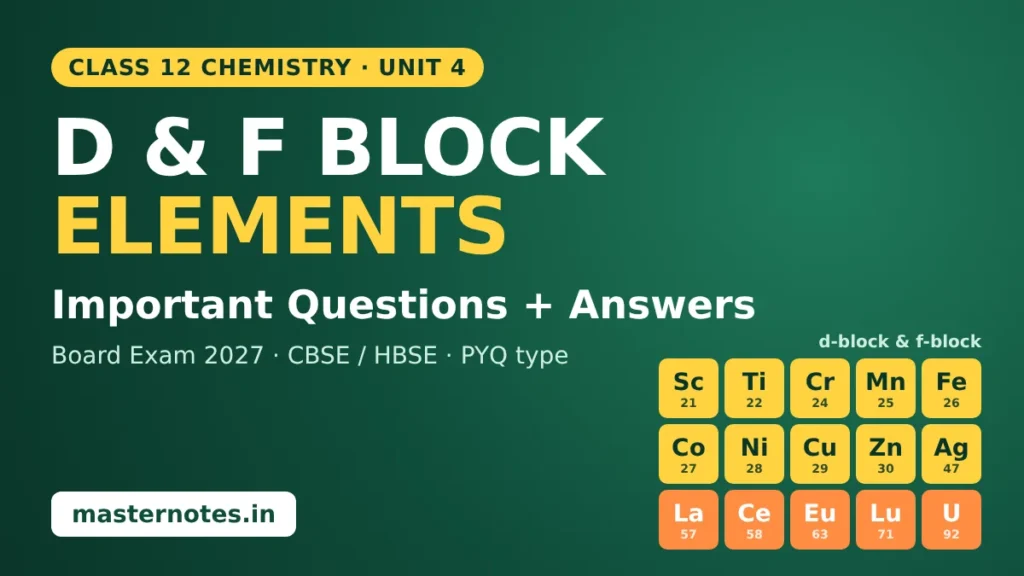
📊 Chapter Snapshot (d and f block elements class 12 weightage)
| Point | Details |
|---|---|
| Chapter | The d and f Block Elements (Unit 4, NCERT Class 12 Chemistry) |
| CBSE marks (2026-27) | 7 marks |
| Most asked topics | Electronic configuration, oxidation states, colour, magnetic moment, lanthanoid contraction, KMnO4 & K2Cr2O7 |
| Question types | MCQ, assertion-reason, “give reasons”, equations, comparison (lanthanoids vs actinoids) |
🧠 Quick Revision Before Questions (d and f block class 12 short notes)
- d-block: groups 3–12; general configuration (n−1)d1–10 ns1–2
- Exceptions: Cr = [Ar] 3d5 4s1, Cu = [Ar] 3d10 4s1 (half-filled and full-filled d are extra stable)
- Transition element: has an incompletely filled d subshell in its atom or in any of its common ions
- Zn, Cd, Hg have full d10 in atom and ions → not regarded as transition elements
- Magnetic moment: μ = √[n(n+2)] BM, where n = number of unpaired electrons
- Lanthanoid contraction: steady decrease in size from La to Lu due to poor shielding by 4f electrons
- Lanthanoids mainly show +3; actinoids show a wider range of oxidation states (5f, 6d, 7s close in energy)
✍️ 1 Mark d and f block elements class 12 important questions (PYQ type)
Q1. Write the general electronic configuration of d-block elements.
✅ (n−1)d1–10 ns1–2 (Pd is an exception: 4d10 5s0).
Q2. Which element of the 3d series shows the highest oxidation state?
✅ Manganese (Mn) shows +7, as in KMnO4.
Q3. Which 3d series element shows only one oxidation state (+3)?
✅ Scandium (Sc).
Q4. Name the transition element with the lowest enthalpy of atomisation in the 3d series.
✅ Zinc — it has no unpaired d electrons, so metallic bonding is weak.
Q5. What is mischmetal? Give one use.
✅ An alloy of about 95% lanthanoid metals and about 5% iron with traces of S, C, Ca and Al. Used in lighter flints and in Mg-based alloys for bullets and shells.
Q6. Which lanthanoid ion is a good oxidising agent in aqueous solution?
✅ Ce4+ — it tends to change to the more stable +3 state.
Q7. What is the colour of chromate and dichromate ions?
✅ Chromate (CrO42−) is yellow; dichromate (Cr2O72−) is orange.
Q8. Calculate the spin-only magnetic moment of Fe2+ (Z = 26).
✅ Fe2+ = 3d6 → 4 unpaired electrons → μ = √(4×6) = √24 ≈ 4.90 BM.
📝 2 Mark Important Questions (d and f block elements class 12 important questions)
Q9. Silver has a completely filled 4d10 configuration. Why is it called a transition element?
✅ In its +2 oxidation state Ag2+ has 4d9, an incompletely filled d subshell. So silver fits the definition of a transition element.
Q10. Why are Zn, Cd and Hg not regarded as transition elements?
✅ They have completely filled d10 orbitals in the ground state as well as in their common oxidation state (+2).
Q11. Why do transition metals form coloured compounds?
✅ Due to partly filled d orbitals. In the presence of ligands the d orbitals split, and an electron absorbs visible light to jump from a lower to a higher d level (d–d transition). The colour we see is the complementary colour. Example: Cu2+ (3d9) is blue, Zn2+ (3d10) is colourless.
Q12. Why do transition metals and their compounds act as good catalysts?
✅ (i) They show variable oxidation states and can form unstable intermediates. (ii) They provide a large surface area for adsorption. Examples: V2O5 in Contact process, finely divided Fe in Haber process, Ni in hydrogenation.
Q13. What are interstitial compounds? Write two properties.
✅ Compounds formed when small atoms like H, C or N get trapped in the crystal lattice of metals, e.g. TiC, Mn4N, Fe3H. They have high melting points and are very hard; they keep metallic conductivity and are chemically inert.
Q14. Why do transition metals form alloys easily?
✅ Their atomic sizes are very similar, so atoms of one metal can easily take the place of another in the crystal lattice.
💡 3 Mark Important Questions – Give Reasons (d and f block elements class 12 important questions)
Q15. What is lanthanoid contraction? Write its causes and two consequences.
✅ Definition: The steady decrease in atomic and ionic radii from La to Lu.
Cause: Imperfect shielding of one 4f electron by another, so the effective nuclear charge increases.
Consequences: (i) Zr (160 pm) and Hf (159 pm) have almost the same size, so they are found together and are hard to separate. (ii) Basic character of hydroxides decreases from La(OH)3 to Lu(OH)3.
Q16. Cr2+ is reducing while Mn3+ is oxidising, though both are d4. Explain.
✅ Cr2+ → Cr3+ gives d3 (stable half-filled t2g level), so Cr2+ loses an electron easily → reducing agent. Mn3+ → Mn2+ gives d5 (extra-stable half-filled d), so Mn3+ gains an electron easily → oxidising agent.
Q17. Why is E°(Mn3+/Mn2+) much more positive than E°(Fe3+/Fe2+)?
✅ Mn2+ has a stable half-filled 3d5 configuration, so Mn3+ → Mn2+ is very favourable (+1.57 V). Fe3+ is itself 3d5, so Fe3+ → Fe2+ is less favourable (+0.77 V).
Q18. Why is E°(Cu2+/Cu) positive (+0.34 V)?
✅ Copper has a high enthalpy of atomisation and high ionisation enthalpy, which is not balanced by its hydration enthalpy. So copper does not liberate H2 from dilute acids.
📘 CBSE Class 12 Sample Question Papers 2026-27 (All Subjects)
D and F Block ke important questions practice karne ke baad, pura board exam 2027 pattern samajhne ke liye latest CBSE SQP (21 Sep 2026) par based ye sample paper books use kar sakte ho.


Other subjects: Computer Science • Accountancy • Business Studies • Economics • Political Science
Disclosure: MasterNotes.in is a participant in the Amazon Associates Program. As an Amazon Associate we earn from qualifying purchases, at no extra cost to you. Prices and availability are shown on Amazon and may change. Saare notes is site par hamesha free rahenge.
Q19. Why is the highest oxidation state of a metal shown in its oxides or fluorides?
✅ Oxygen and fluorine are small and highly electronegative. Oxygen can also form multiple bonds with the metal, so oxides show even higher states (Mn2O7, +7) than fluorides (MnF4, +4).
Q20. Why do actinoids show a wider range of oxidation states than lanthanoids?
✅ In actinoids the 5f, 6d and 7s orbitals have comparable energies, so a variable number of electrons can be used in bonding.
Q21. Transition metals have high enthalpies of atomisation. Why?
✅ They have a large number of unpaired electrons, which take part in strong metallic bonding (interatomic interaction).
🧪 5 Mark d and f block elements class 12 important questions — KMnO4 and K2Cr2O7
Q22. How is potassium dichromate prepared from chromite ore? Write its reactions with iodide, iron(II) and H2S in acidic medium.
👉 Step 1 – Fusion of chromite ore with sodium carbonate in air:
4FeCr2O4 + 8Na2CO3 + 7O2 → 8Na2CrO4 + 2Fe2O3 + 8CO2
👉 Step 2 – Acidification (yellow chromate → orange dichromate):
2Na2CrO4 + 2H+ → Na2Cr2O7 + 2Na+ + H2O
👉 Step 3 – Treatment with KCl:
Na2Cr2O7 + 2KCl → K2Cr2O7 + 2NaCl
⚗️ Oxidising reactions (acidic medium):
Cr2O72− + 14H+ + 6I− → 2Cr3+ + 3I2 + 7H2O
Cr2O72− + 14H+ + 6Fe2+ → 2Cr3+ + 6Fe3+ + 7H2O
Cr2O72− + 8H+ + 3H2S → 2Cr3+ + 3S + 7H2O
💡 Remember: chromate and dichromate change into each other with pH — 2CrO42− + 2H+ ⇌ Cr2O72− + H2O. Dichromate has two tetrahedra sharing one oxygen (Cr–O–Cr angle 126°).
Q23. How is potassium permanganate prepared from pyrolusite (MnO2)? Write its reactions with Fe2+, oxalate and iodide.
👉 Step 1 – Fusion of MnO2 with KOH in air (or with KNO3):
2MnO2 + 4KOH + O2 → 2K2MnO4 (dark green) + 2H2O
👉 Step 2 – Disproportionation in neutral or acidic solution:
3MnO42− + 4H+ → 2MnO4− + MnO2 + 2H2O
(Commercially, manganate is oxidised to permanganate by electrolytic oxidation in alkaline solution.)
⚗️ Oxidising reactions (acidic medium):
MnO4− + 8H+ + 5Fe2+ → Mn2+ + 5Fe3+ + 4H2O
2MnO4− + 16H+ + 5C2O42− → 2Mn2+ + 10CO2 + 8H2O
2MnO4− + 16H+ + 10I− → 2Mn2+ + 5I2 + 8H2O
💡 In neutral or faintly alkaline medium: 2MnO4− + H2O + I− → 2MnO2 + 2OH− + IO3−
⚖️ Lanthanoids vs Actinoids (Easy Table) – d and f block class 12 PYQ
| Lanthanoids | Actinoids |
|---|---|
| 4f orbitals are filled | 5f orbitals are filled |
| Mainly +3 oxidation state (some +2, +4) | Wide range: +3 to +7 |
| Mostly non-radioactive (except promethium) | All are radioactive |
| Less tendency to form complexes | Greater tendency to form complexes |
| Lanthanoid contraction is smaller | Actinoid contraction is larger (poorer shielding by 5f) |
| Do not form oxocations | Form oxocations like UO22+, PuO22+ |
🎯 Most Repeated “Give Reasons” — d and f block elements class 12 important questions
| Question | Key point to write |
|---|---|
| Sc3+, Ti4+, Zn2+ are colourless | No unpaired d electron (d0 or d10) → no d–d transition |
| MnO4− is intensely coloured though Mn is d0 | Charge transfer from oxygen to manganese, not d–d transition |
| Zr and Hf have similar properties | Almost equal size due to lanthanoid contraction |
| 5d series has higher ionisation enthalpy than 4d | Poor shielding by 4f electrons increases effective nuclear charge |
| Transition metals are paramagnetic | Presence of unpaired d electrons |
| Actinoid chemistry is complicated | Radioactive, wide range of oxidation states, short half-lives |
| Cu+ is unstable in water | Cu2+ has much higher (more negative) hydration enthalpy, so 2Cu+ → Cu2+ + Cu |
Masternotes – Homepage
📚 More free Class 12 Chemistry notes, practical files and guess papers 👉 Homepage | Class 9-12 Guess Papers
💬 FAQs — d and f block elements class 12 important questions
Q1. How many marks does d and f block carry in CBSE Class 12?
In the CBSE 2026-27 syllabus, Unit 4 (d and f Block Elements) carries 7 marks.
d and f block important questions for board exam
Q2. Which topics do most d and f block elements class 12 important questions come from?
Electronic configuration, oxidation states, coloured ions, magnetic moment, catalytic property, lanthanoid contraction, and the preparation and reactions of KMnO4 and K2Cr2O7.
Q3. Are these questions useful for HBSE students?
Yes. HBSE follows the NCERT book, so the same concepts and question types are asked.
Q4. How do I calculate magnetic moment quickly?
Find the number of unpaired electrons (n) and use μ = √[n(n+2)] BM. For n = 1, 2, 3, 4, 5 the values are 1.73, 2.83, 3.87, 4.90 and 5.92 BM.
Q5. Where can I read the full handwritten notes of this chapter?
👉 D and F Block Elements Class 12 Notes on MasterNotes.in.
🚀 Final Revision Tips :- d and f block important questions for board exam
- 🔹 Learn the configurations of Cr and Cu — they are asked every year in some form.
- 🔹 Write all KMnO4 and K2Cr2O7 equations 3 times; balanced equations give full marks.
- 🔹 For “give reasons” questions, always use the words half-filled / fully-filled stability, unpaired electrons or lanthanoid contraction.
- 🔹 Practise the magnetic moment values table — it is a sure 1-mark question.
- 🔹 Revise the lanthanoids vs actinoids table the night before the exam.
Practise these d and f block elements class 12 important questions at least twice before the exam. All the best for your board exams! 💪 Keep learning with MasterNotes.in.


